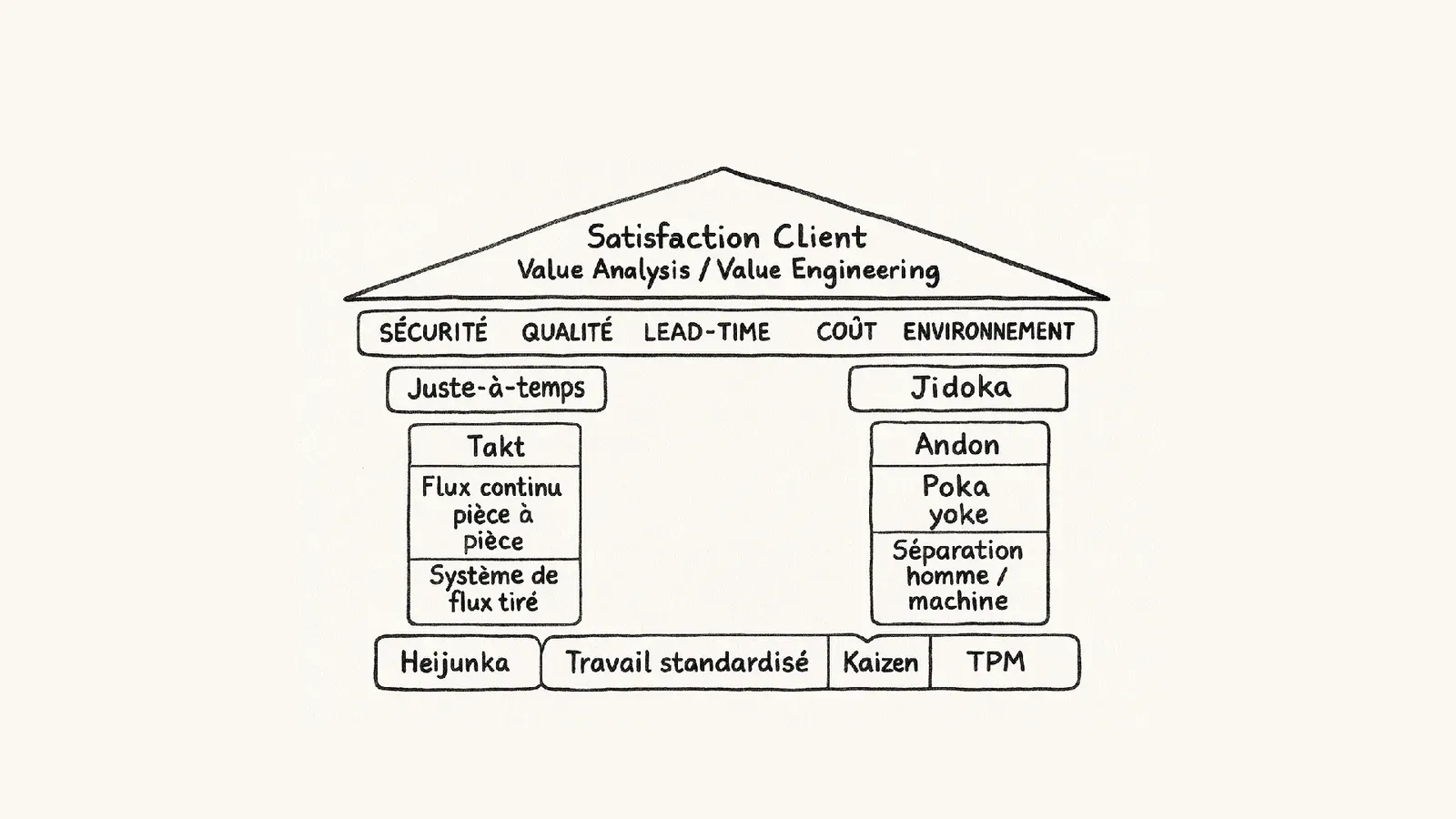
Applying Lean to hiring means cutting every step that adds no value, either for the hiring manager or for the candidate. In France, according to the software company Tellent in an interview with France Travail (opens a new window) (the French public employment service) in July 2025, companies hold an average of eight interviews spread over 39 days before filling a role, and 60% of candidates drop out of the process because of its length and complexity. The method comes from Toyota's Japanese factories and boils down to three actions: observe real cases, stop errors as soon as they appear, set time standards.
What is Toyota's Lean?
According to the Lean Enterprise Institute (LEI), Lean is a way of thinking about creating value with fewer resources and less waste. It draws on the Toyota Production System. Kiichiro Toyoda, Taiichi Ohno and others at Toyota studied the limits of mass production as early as the 1930s, then more intensively just after the Second World War. They then revisited Ford's thinking and invented this system (opens a new window). Its tools have moved beyond the factory: services, healthcare and even public administration, the LEI points out.
The system rests on two pillars (opens a new window), according to Toyota:
- Jidoka: stop immediately as soon as an anomaly is detected, so as not to make defective products.
- Just-in-Time: produce only what is needed, when it is needed and in the quantity needed.
Continuous improvement goes by another name, kaizen, which all Toyota employees practise every day. Its target, waste, is called muda: any activity that consumes resources without creating value for the customer, the LEI specifies. In hiring, the customer takes two forms: the manager who expects a new hire who can hit the ground running and the candidate who expects a clear process.
Where does waste hide in hiring?
In waiting time, in management sign-offs and in interviews that keep multiplying. According to Tellent, risk aversion, added to the cost of a failed hire, pushes companies to multiply approval steps. In Germany or the Benelux, Tellent notes, the average is more like four to five interviews over 37 days.
The seven wastes classified by Taiichi Ohno (opens a new window) are typical of mass production. On our reading, three of them can be found in hiring:
- Waiting: the candidate waits for feedback, the manager waits for a shortlist.
- Unnecessary processing: one more interview that asks no new question, one more management sign-off.
- Correction, meaning inspection, rework and scrap: multiplying checks at the end of the process, reopening the search after a failed hire.
On the candidate side, young people say a process becomes a deal-breaker beyond 22 days, and a third of companies admit to going past that, according to the JobTeaser and EDHEC study (opens a new window) of October 2024.
Lean tools adapt to hiring
The LEI documents gemba, jidoka, the five whys and PDCA. The pieces, the bins and the PISCAR framework are our own adaptation for hiring.
Observing on the ground: gemba and pieces
Gemba means the "real place" where value is created, the LEI explains. In hiring, that means your actual hiring records. Go back over your most recent closed hires and date each step: application, qualification call, interviews, decision, response. Treat each application as a "piece" and compare them on common variables: length of the process, number of interviews, source, people met. Spot where each file sits waiting.
Green bins, red bins: learning from every case
Our method: sort each hire into a bin. The green bin holds the successes, to be repeated and standardised. The red bin holds the failures, to be analysed rather than forgotten: which step would have revealed the gap earlier? Distinguish normal failures (a candidate does not match the role, which is natural in a selective process) from abnormal ones (a candidate who should have been ruled out much earlier). Only the latter need to be eliminated.
Stopping early: the recruiter's jidoka
Jidoka builds quality into every step, the LEI notes. At the first deviation, you stop the line. Your stop line is telephone screening, which 71% of companies that hired a manager in 2025 used at least once, according to Apec (opens a new window) (the French executives' employment agency). Set the knock-out criteria in advance and check them first. Consider an AI engineer whose technical level is not tested until the second interview: if the gap is too big, all the time invested is lost. A preliminary algorithms test would have ruled out this candidate earlier.
Solving problems: PISCAR, five whys and PDCA
Deal with a failed hire while it is fresh, on a specific case. For this we suggest a six-step framework, PISCAR:
- Problem: a negative deviation from a standard. Example: a candidate reaches the shortlist without their key skill having been validated.
- Impact: time lost, cost, risk for the team.
- Ideal situation: every critical skill assessed from the first interview.
- Causes: the five whys consist in asking "why?" repeatedly to reach the root cause, the LEI specifies. Here: why was the skill not validated? Because no technical question was asked. Why? The interview guide did not mention it. Why? It is not standardised from role to role.
- Actions: corrective, with an owner and a deadline. Example: update the guide by the end of the week.
- Results: measurable, for example zero omissions on critical skills in the next three hires.
PDCA (plan, do, check, act) then takes over. Introduced in Japan by W. Edwards Deming in the 1950s, this cycle tests a change, measures the result, then standardises it or starts again, the LEI says.
Which timings and indicators should you track?
See hiring as a flow, from application to hire. Two indicators are enough.
- Time to hire: the time a candidate spends in the process. For managerial hires, the average length of the most recent hiring process rose from 9 to 12 weeks between 2020 and 2022, then stayed stable over the past two years, Apec notes (May 2026). Set a maximum time for each stage, from the qualification call to the offer. Just-in-Time supplies the rule: leave neither files nor information waiting.
- Pass-through rates: the share of candidates who move from the call to the first interview, from the first interview to the offer, and from the offer to acceptance.
On the number of interviews, Tellent estimates that you should ideally not go beyond four. Two levers: a clear brief with managers from the start, and panel interviews, where the candidate meets several managers in a single meeting.
Also measure manager and candidate satisfaction with a questionnaire after each hire: the new hire's relevance and integration on one side, clarity of the process and the gap between promise and reality on the other. The stakes go beyond the role: 77% of young people who had a bad experience applying say the company's image has worsened, according to the same JobTeaser and EDHEC study.
Is there a hire you need to speed up? Entrust the mission to a headhunter: at Muzzo, the signature comes 26 days after the brief on average. Launch a mission (opens a new window)
FAQ
What are the two pillars of the Toyota Production System?
Jidoka and Just-in-Time, according to Toyota. The first stops work as soon as an anomaly appears, the second produces only what is needed, when it is needed. In hiring: rule out a candidate as soon as a knock-out criterion is confirmed, and let no file wait.
How long does hiring take in France?
For managerial hires, the average length of the most recent hiring process reached 12 weeks in 2022 and has stayed stable for two years, according to Apec (May 2026). Across all roles, Tellent counts eight interviews spread over 39 days. These two measures do not cover the same populations.
How many interviews should you plan for a hire?
Ideally no more than four, according to Tellent, whereas companies hold eight on average. Cutting the number does not lower your standards: a clear brief with managers and panel interviews save time.